Thursday, February 28, 2019

The last time GE's stock did this, it tanked 45 percent

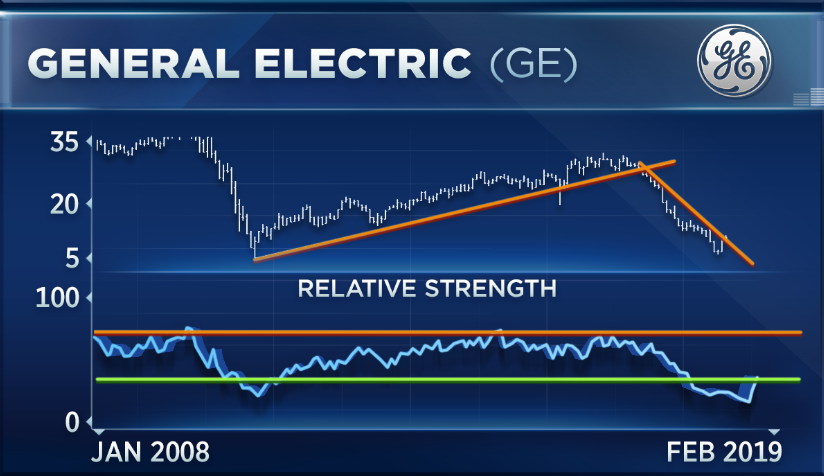
Shares of General Electric are approaching a key level that has historically sparked big reversals in the stock.

GE's stock rallied as much as 13 percent on Monday after the embattled company said it will sell its life sciences business to Danaher, GE CEO Larry Culp's former employer. They were up 3 percent in Tuesday's premarket.

The rally comes as the company has soared more than 60 percent off its now infamous $6.66 bottom in December, and follows a multiyear downtrend fueled by a combination of high restructuring costs, weak performance in key lines of business, crippling one-time charges and top-level executive changes.

But there's one under-the-radar indicator that could point to trouble ahead: the average analyst price target.

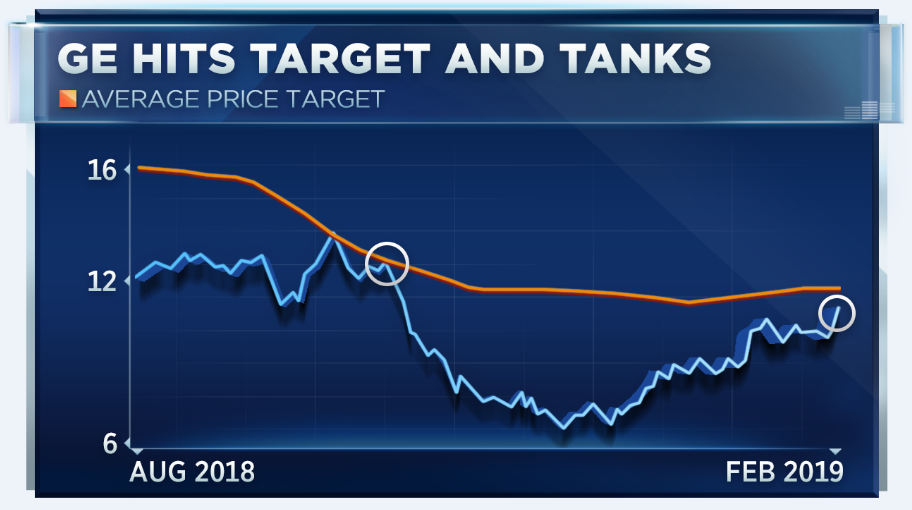
On at least two occasions, including in July 2016, GE's stock crossed over its average analyst price target only to reverse course and collapse in the following weeks. In October, GE shares briefly rose above Wall Street's average price target of $11.52 before spiraling 45 percent to its mid-December lows.

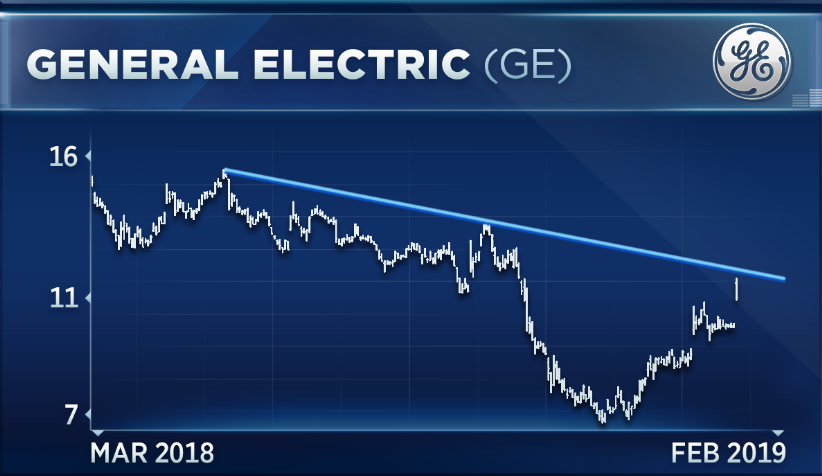
Now that GE's stock has climbed above $11 a share for the first time since October, there's a risk it could reverse if it breaches its $11.62 average price target, Newton Advisors' Mark Newton said Monday on CNBC's "Trading Nation." The stock closed less than a dollar away from that level on Monday, at $10.82 a share.

"I do think it's had a decent run, and there are some technical reasons to suggest it likely stalls here and pulls back," Newton said.

But that doesn't mean all is lost for GE's long-term investors, Newton said. While he did see "pretty serious overhead resistance" in the $11.50 to $12 range, he said the stock seems to be building in a bottom here that could create a buying opportunity in the coming weeks.

"For a long-term investor, I do think it's in a bottoming process," he said. "It should be held, particularly for those that have bought up near $33 a couple of years ago."

The technician added that a near-term pullback will likely give "longer-term investors maybe a better-suited area to buy in the weeks ahead."

Chantico Global CEO Gina Sanchez also sees a good deal of upside, telling CNBC that most of Wall Street was in favor of the company's move to sell off its biopharmaceutical business.

"Biopharma was a great unit, but it didn't necessarily fit in the rest of GE Healthcare, so it was a perfect unit to sell in order to generate money ... and reduce their debt, and that is really a critical key for them right now," she said on "Trading Nation." "There are very few people who are going to look at this and say, 'That's a bad move.'"

Now, the question is whether the company can execute on reducing its debt load, and for Sanchez, much of that still remains to be seen.

"Deleveraging is one thing; getting the business back in order is a whole different story. For a long time, [GE shares] were really trading at option value, and so I think still a lot remains to be seen in terms of the execution."

GE shares are up 42.61 percent this year.

Disclaimer

Tuesday, February 26, 2019

Surge Energy Inc (SGY) To Go Ex-Dividend on February 27th

Surge Energy Inc (TSE:SGY) announced a monthly dividend on Wednesday, February 27th, TickerTech reports. Shareholders of record on Friday, March 15th will be paid a dividend of 0.0083 per share on Friday, March 15th. This represents a $0.10 dividend on an annualized basis and a yield of 7.17%. The ex-dividend date of this dividend is Wednesday, February 27th.

Surge Energy stock traded up C$0.01 during mid-day trading on Tuesday, reaching C$1.39. The company had a trading volume of 276,796 shares, compared to its average volume of 1,143,311. Surge Energy has a fifty-two week low of C$1.22 and a fifty-two week high of C$2.76. The company has a debt-to-equity ratio of 37.50, a current ratio of 0.92 and a quick ratio of 0.77. The firm has a market capitalization of $423.72 million and a P/E ratio of -73.16.

Get Surge Energy alerts:

A number of analysts have weighed in on the stock. BMO Capital Markets cut their target price on shares of Surge Energy from C$3.50 to C$3.00 and set an “outperform” rating on the stock in a research report on Tuesday, October 30th. CIBC cut their target price on shares of Surge Energy from C$3.00 to C$2.50 in a research report on Thursday, November 22nd. Royal Bank of Canada cut their target price on shares of Surge Energy from C$3.00 to C$2.50 in a research report on Tuesday, January 8th. Canaccord Genuity cut their price target on shares of Surge Energy from C$3.75 to C$2.75 in a report on Thursday, January 10th. Finally, GMP Securities lowered shares of Surge Energy from a “buy” rating to a “hold” rating and cut their price target for the stock from C$3.00 to C$1.85 in a report on Thursday, December 13th. One research analyst has rated the stock with a hold rating and five have issued a buy rating to the company. Surge Energy currently has a consensus rating of “Buy” and a consensus price target of C$2.60.

In other Surge Energy news, insider James Leigh Stannard purchased 25,000 shares of the business’s stock in a transaction dated Tuesday, December 4th. The shares were bought at an average price of C$1.62 per share, for a total transaction of C$40,500.00. In the last quarter, insiders have bought 57,092 shares of company stock worth $87,323.

WARNING: “Surge Energy Inc (SGY) To Go Ex-Dividend on February 27th” was first posted by Ticker Report and is owned by of Ticker Report. If you are reading this piece on another publication, it was copied illegally and reposted in violation of U.S. & international copyright & trademark law. The original version of this piece can be viewed at https://www.tickerreport.com/banking-finance/4181698/surge-energy-inc-sgy-to-go-ex-dividend-on-february-27th.html.

Surge Energy Company Profile

Surge Energy Inc engages in the exploration, development, and production of oil and gas properties in western Canada. The company holds interests in the Valhalla/Wembley property located to the northwest of Grand Prairie in northwestern Alberta; the Nipisi property located to the north of the town of Slave Lake, in northwestern Alberta; and the Nevis property located to the east of Red Deer, Alberta.

Recommended Story: What are the benefits of a balanced fund?

Dividend History for Surge Energy (TSE:SGY)

Monday, February 25, 2019

US-China trade dispute puts a chill on American natural gas export boom

The natural gas market is emerging from winter relatively unscathed despite potentially disruptive Chinese tariffs on U.S. gas. But the ongoing trade dispute is still putting a chill on cooperation between the two energy powerhouses and threatens to sideline billions in investment.

Chinese tariffs on U.S. natural gas have halted Beijing's purchases of U.S. LNG, a form of the fuel chilled to liquid form for transport by sea. The trade dispute has also delayed at least one LNG export terminal slated for construction in Louisiana and threatens to push back the start date for other facilities.

In the long-run, analysts say it's inevitable for gas trade to resume between China and the U.S. China is the engine behind growing LNG demand, while the U.S. is the world's top natural gas producer.

"They're just the elephant in the room and until there's clarity on where China is going to source their natural gas ... then it's hard for other buyers to make decisions about which projects to attach themselves to." -Katie Bays, head of energy and utilities, Height Capital Markets

"They're certainly a very good fit," said Alex Munton, principal analyst for gas and LNG at energy research firm Wood Mackenzie. "On the one hand, China is the fastest growing LNG market and the U.S. is the fastest growing LNG supplier."

But a breakthrough on gas trade depends on reaching a deal on separate issues that are difficult to resolve.

Beijing and Washington are reportedly hammering out a blueprint to address those tough issues, from assuring American companies have access to Chinese markets to protecting U.S. intellectual property. However, it now appears that negotiators will move the goal line back from the original March 1 deadline to strike a deal — forestalling a potential increase in tariffs, but delaying the removal of China's current 10 percent tax on U.S. LNG.

The dispute comes as developers are planning a second wave of U.S. LNG export terminals, mostly along the Gulf Coast. The trade feud is also continuing as the Federal Energy Regulatory Commission on Thursday broke an impasse that held up key approvals for new U.S. LNG export terminals.

show chapters Energy sector finding new markets in Europe, industry expert says Energy sector finding new markets in Europe, industry expert says    7:45 AM ET Mon, 28 Jan 2019 | 02:47

Greenlighting those projects usually requires lining up long-term customers who will commit to buying LNG once the terminal is complete.

Despite its appetite for LNG, China has not signed many of those contracts with U.S. companies. Only one American firm, LNG pioneer Cheniere, has signed a long-term contract with a Chinese company since Beijing approved the deals with state-owned enterprises nearly two years ago.

The 'elephant in the room'

Now, the tariffs are creating uncertainty for developers aiming to line up Chinese buyers. Last fall, Australia's LNG Limited said talks with potential Chinese customers stalled because of the tariffs, forcing the company to put off a final decision on financing its planned Magnolia export terminal in Louisiana.

"Clearly there is an issue for some projects if they are targeting the China market," Munton said. "We do think it's going to be difficult in the current context for deals to be signed."

Since Chinese companies are major players in the LNG market — China is now the second largest LNG importer — their reluctance to commit to U.S. projects threatens to keep other buyers on the sidelines, says Katie Bays, head of energy and utilities at Height Capital Markets.

"They're just the elephant in the room and until there's clarity on where China is going to source their natural gas ... then it's hard for other buyers to make decisions about which projects to attach themselves to," she said.

Still, some projects are moving forward. This month, Exxon Mobil and Qatar Petroleum decided to finance their Golden Pass project on the U.S. Gulf Coast.

The Golden Pass LNG Terminal in Sabine Pass, Texas. Source: Golden Pass LNG The Golden Pass LNG Terminal in Sabine Pass, Texas.

But analysts say the project is somewhat unique since it's backed by the largest publicly traded oil company and the world's second largest LNG producing nation. Those heavyweights have the financial flexibility to invest through uncertainty, unlike an independent player like LNG Limited, which needs firm commitments from customers to move forward.

But there are signs there's enough demand beyond China to keep some U.S. LNG projects on track for the time being. Last year, developers signed agreements for about 20 million tons in annual sales to support new U.S. capacity, according to Wood Mackenzie.

LNG developers are still getting commitments from energy traders like Trafigura and Vitol, as well as big integrated oil and gas companies that also buy and sell the fuel. State-controlled companies from Poland to Taiwan are also signing agreements.

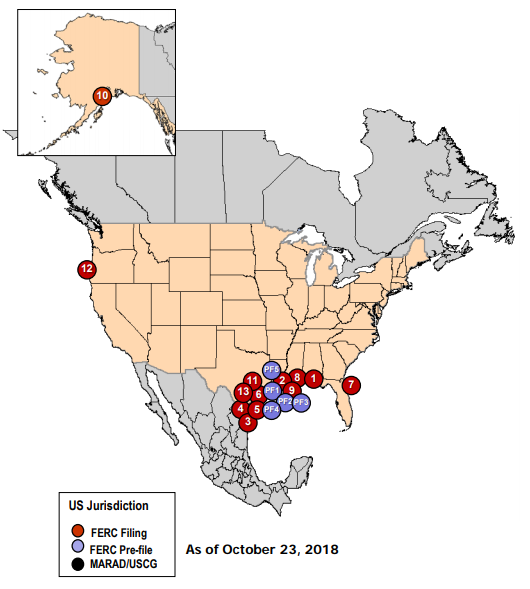
Proposed North American LNG export terminals, source: FERC

That should allow a few projects to move forward in 2019, including an expansion at Cheniere's Sabine Pass terminal and Venture Global's new Calcasieu Pass facility in Louisiana.

"I think there's enough room with China not embracing U.S. LNG to allow for further gains in LNG exports from the U.S., but it would make things easier if China would take contracts, and they have yet to do it," said Richard Redash, head of research for North American gas and power analytics at S&P Global Platts.

Growing players in LNG spot market

There are obstacles to U.S.-China LNG trade, but the two nations are growing players in the spot market, where LNG is purchased for immediate delivery.

While most LNG is still sold in long-term contracts, China sources about half of its LNG on the spot market, according to Bays. Meanwhile, the U.S. is also unique among suppliers because its relatively young LNG industry is built around selling into the spot market to a greater degree than in other countries.

China's tariff on U.S. LNG introduced inefficiencies into the spot market, threatening to raise prices for all buyers this winter. But warm temperatures in Asia and preemptive stockpiling by China and other regional buyers helped crush LNG prices, swamping any inflationary impact from tariffs.

show chapters GasLog CEO: Huge political drive in China to make LNG work GasLog CEO: Huge political drive in China to make LNG work    5:48 AM ET Fri, 24 Aug 2018 | 02:34

The benchmark JKM contract for Asian LNG fell from about $12 per million British thermal units when China imposed tariffs on U.S. LNG to just over $6 per mmBtu, according to S&P Global Platts.

Supply has also helped to push down prices. Despite the Chinese tariffs, S&P Global Platts reports the U.S. is still pushing out record amounts of LNG, nearly 5 billion cubic feet a day in February.

"The resource potential in the United States is huge and it can satiate a lot of what China needs," Redash said.

Yet he says the U.S. can't take the Chinese market for granted, even if Washington and Beijing end the trade dispute.

"There will be some competition on the global front on the supply side of the equation, and it's something that we have to watch very carefully, especially over the next year or two."

Thursday, February 21, 2019

3 Stocks That Are Absurdly Cheap Right Now

One primary goal of any investor should be to buy stocks for less than they're worth. But in today's market, it's seldom clear when a stock is truly undervalued relative to the potential of its underlying business. 

So we asked three top Motley Fool contributors to each find a stock they believe is absurdly cheap right now. Read on to learn why they chose Tencent (NASDAQOTH:TCEHY), ExxonMobil (NYSE:XOM), and JD.com (NASDAQ:JD).

Red SALE SALE SALE Sign in a shop window

IMAGE SOURCE: GETTY IMAGES.

Tencent's (gaming) ball is finally rolling

Steve Symington (Tencent): Chinese gaming and internet-service giant Tencent suffered over the past year, when a government regulatory shakeup led to an extended freeze in approvals for new game licenses -- though the company most recently managed to post respectable growth in the third quarter despite not being able to monetize some of its most promising game titles. For that, Tencent investors could thank the company's burgeoning social-media streaming, digital content, and online advertising businesses.

In December, however, Chinese regulators finally began to wade into their backlog of license requests. And though Tencent's games were absent from the list of approvals at first, shares began to rally as two of its mobile game titles finally made the cut late last month. 

As it stands, Tencent has rallied nearly 40% from its 52-week low set in late October. But shares are still down almost 30% over the past year. The stock might not look particularly cheap trading at around 29 times this year's expected earnings. But I think they'll prove a bargain for investors willing to buy now before Tencent's gaming rebound becomes evident. 

This oil giant is on sale in a big way

Reuben Gregg Brewer (ExxonMobil): You'd jump at the chance to buy a U.S. postage stamp, which today costs $0.55, for the price it cost in 1995, when it was just $0.32, or, even better, in 1988 for just a quarter. That's not going to happen, but you can buy ExxonMobil Corporation for valuations that, incredibly, hark back to those eras. The giant integrated oil major's yield hasn't been as high as it is today since the 1990s. And the stock's price to tangible book value hasn't been this low since the 1980s. 

XOM Dividend Yield (TTM) Chart

XOM Dividend Yield (TTM) data by YCharts

The oil company is cheap for a reason, including slumping production in recent years and elevated spending plans. However, it appears Exxon is righting the ship. The most direct example is two quarters of sequential production increases, driven largely by increased drilling in the onshore U.S. market. That's just one of the company's big projects, however, so there's likely to be more good news on the production front as it works through its 2025 growth plan. The early success of this effort, meanwhile, hints that the spending Exxon has on tap -- as much as $30 billion a year -- will be worth the cost.

Investors, however, are still not convinced that the company can pull off a turnaround. But with long-term debt at just 10% or so of the capital structure, there's little reason to doubt Exxon's ability to spend heavily no matter what happens to oil prices. If you can take a long-term view, you can collect more than a 4.3% yield from a historically cheap stock with a turnaround story that looks like it's just starting to unfold. 

A Chinese e-commerce behemoth

Leo Sun (JD.com): JD is China's second largest e-commerce player, after Alibaba (NYSE:BABA). The stock was cut in half over the past 12 months on concerns about slowing sales growth, rising expenses, and a recently dropped rape allegation against its founder and CEO, Richard Liu. Trade tensions and a broader market downturn in growth stocks exacerbated that pain.Yet JD's stock now trades at just 0.5 times its projected sales this year. That's a remarkably low ratio compared with its estimated sales growth of 30% this year. JD's sales growth decelerated over the past year, partly because of slower sales of big-ticket electronics and appliances, but it's still expected to post 19% sales growth next year.

JD's profitability was uneven over the past year, because of aggressive investments in its online marketplace,its  logistics network, and its Prime-like "JD Plus" membership plans. However, JD believes that these ambitious efforts, which include autonomous robots and delivery drones, will pay off and boost its margins over the long term. JD also recently started offering its logistics services to other companies as a paid service.

Analysts expect JD's earnings to decline 47% this year as its expenses rise. But they also expect that figure to more than double next year as it moves past those investments. That means JD's forward P/E of 49, which doesn't seem cheap, could quickly contract as its earnings improve.

That's why JD is buying back its own stock, and why Tencent (NASDAQOTH:TCEHY), Walmart (NYSE:WMT), and Alphabet's (NASDAQ:GOOG) (NASDAQ:GOOGL) Google all hold stakes in the company. It might be smart to follow their lead.

Everyone loves a bargain

In today's fast-changing world, we can't guarantee that these three stocks will go on to beat the market. But whether we're talking about the turnaround of Tencent's gaming business, Exxon's historically low valuation, or JD.com's deceivingly inexpensive shares and long-term-oriented investments in its business, we believe they're poised to do exactly that. And we think investors would do well to put their money to work accordingly.

Amazon’s HQ2 Saga Continues While Capitol Hill Targets Buybacks

On this episode of Motley Fool Money, host Chris Hill together with Motley Fool analysts Jason Moser, Andy Cross, and Ron Gross hit on this week's biggest stories in the market. NVIDIA (NASDAQ:NVDA) shares popped 10%, but shareholders should temper some of their excitement. Coca-Cola (NYSE:KO) and Pepsi (NASDAQ:PEP) both reported, and the market really seems to prefer the blue team this time around. Under Armour (NYSE:UA) (NYSE:UAA) is getting its act together but still has some big challenges ahead. Activision Blizzard (NASDAQ:ATVI) remains crushed amid competition and layoff concerns. And, as always, the guys share some stocks on their radar this week. Also, Chris Hill talks with corporate governance expert and movie critic Nell Minow about Capitol Hill's new interest in buybacks, Facebook's (NASDAQ:FB) big governance problems, and some predictions for the Academy Awards.

A full transcript follows the video.

This video was recorded on Feb. 15, 2019.

Chris Hill: It's the Motley Fool Money radio show! I'm Chris Hill. Joining me in studio this week, senior analysts Jason Moser, Andy Cross, and Ron Gross. Good to see you as always, gentlemen! We've got the latest headlines from Wall Street. We'll talk stock buybacks and get an Oscars preview from our guest Nell Minow. And, as always, we'll give you an inside look at the stocks on our radar.

Guys, just when you thought the Amazon (NASDAQ:AMZN) HQ2 nightmare was over! This week, Amazon announced it is dropping the deal to build a second headquarters in New York City due to rising political protests. The one here in Northern Virginia is still on. That means, among other things, Jason, that the second headquarter location close to Ron Gross' house is still very much --

Ron Gross: [laughs] Back on the table?

Andy Cross: And mine!

Jason Moser: It's still on the table. It always struck me as odd that they chose New York to begin with. It just didn't seem like it was really in the center of the conversation. But they went with it, and now they're not going with. It seems like a lot of political back-and-forth. I don't know that I necessarily have an opinion on that. It does seem to me, the political concerns are perhaps a little bit more short-sighted. It seems like in the press that the story is being communicated that Amazon was going to get all of these incentives. It's important to remember, these incentives were based on conditions. There were conditions where they had to meet certain numbers regarding hiring, and then they would receive these incentives. It wasn't like New York was just giving up all of this stuff. There was a performance bonus involved with all of this.

With that said, it does sound like it went down to the final hour and they couldn't make it work, so you just move forward. It ought to bring a few more jobs here to Virginia, I would imagine.

Hill: Like you, I was a little surprised when they split it between northern Virginia and New York City. But Andy, you were saying before we started taping, you weren't surprised?

Cross: Yeah. Actually, according to the Brookings Institution, New York has one of the largest tech forces in America, followed by Washington, D.C. Those two big markets have lots of tech people that Amazon could hire. To me, for this one, it seemed like Amazon was pushing what they wanted, and they got a little pushback and they didn't like it, so they said, "Hey, we're taking our jobs elsewhere."

Gross: Which is their prerogative. I don't think this hurts Amazon in any way. I hope it doesn't hurt those communities that are going to not have the capital investment that Amazon was going to bring. But I don't think Amazon misses a beat.

Moser: Yeah, I think you're right. This doesn't hurt Amazon. New York needs Amazon more than the other way around. It was really interesting to read the stories about all the real estate speculation that began as soon as this decision was made. Judging from what I was reading, real estate agents were taking requests, purchases were being made sight unseen via text message and whatnot. And lo and behold, now it seems like they're not necessarily going to have that same business landscape that they thought they might have. I'm sure there probably are some real estate investors/ speculators that are feeling a little bit of the pinch right now.

Hill: Well, fingers crossed that they pull the trigger quick. I'd really hate to think that in six months, we're still talking about taking this story.

Gross: Yeah, I'm fatiguing on the whole thing.

Hill: [laughs] Alright, let's get to the week's earnings news. Shares of NVIDIA up nearly 10% this week. Fourth quarter profits came in higher for the chip maker. Andy, it's been a rough 12 months for shareholders. I'm wondering, is this a representation that NVIDIA turned things around? Or was this a stop-the-bleeding situation?

Cross: I think it's the latter, Chris, it's stop-the-bleeding. I think investors looked at this and said, "OK." They're talking about how the inventory hangover from the crypto boom, which drove a lot of their gaming sales revenues and growth over the last couple of years, which caused problems when that market suffered last quarter, and the stock fell from $280 down to $130 over the course of a couple of months. They said that will play out mostly through this first quarter. While the growth picture for NVIDIA will probably basically be about flat this year, investors are saying, at least that crypto boom hangover has now passed. We still have the China concerns, but that's a good sign for NVIDIA and for the shareholders as well.

Hill: In terms of NVIDIA's management, safe to assume you like this strategy of downplaying expectations for 2019?

Cross: I do, yes. They're still the leader in these high-end graphics cards. AMD and Intel are coming after them and very competitive. NVIDIA has this lead. Jensen Huang, who owns 3% of the company, more than the $3 billion, the CEO and the founder of the business, continues to innovate. They have some pricing power, although they started saying, "Listen, we're going after the mid-tier pricing." I still think they're downplaying a little bit of the potential across all of their units. Gaming was down but data center was up, visualization was up, automated was up. Their other lines of business continue to drive the growth in NVIDIA. If they can get through the gaming side on the crypto craze from last quarter, that's a good sign for NVIDIA.

Hill: Coca-Cola and Pepsi both out with fourth-quarter reports this week. Both dealing with foreign-currency headwinds, but investors seem more confident in Pepsi's business, Ron. On Thursday, shares of Coca-Cola had their worst day in over a decade.

Gross: Oof. Neither company is knocking it off the ball over the last year, but I think Pepsi, at least the perception is that they've reacted to changing consumer preferences a bit better. Partly through acquisitions like SodaStream and Bare Foods.

While they both lowered guidance, Coke's was more serious. It was based on lower revenue growth, slowdown in emerging markets. Pepsi's were more like currency headwinds, tax rates, making investments to actually grow the business. So I think investors gave Pepsi a pass while Coke got slammed.

Hill: When you think about acquisitions, Pepsi has the Frito-Lay business. They can make acquisitions in the salty-snack industry in a way that Coca-Cola probably is never going to.

Gross: It's not there. They're willing to spend the money, as they have recently with Bare Foods, to go with those changing consumer preferences. People don't like sugar anymore, it turns out, and --

Hill: Whoa, whoa, hold on!

Moser: Hold on a second, now!

Hill: Some of us still like sugar!

Gross: Perhaps some people no longer like sugar as much as they once did. Pepsi is reacting to it. Now, Coke is, too, let's not forget. Coke is actually going to be introducing the Orange Vanilla Coke in the near future. I'm not sure I like the sound of that. I think people like the taste of orange vanilla together. Is that a Creamsicle? Yeah, that's a Creamsicle, maybe that works. But, as we go toward healthier items, I'm not sure that's the way to go.

Cross: Orange Julius, baby!

Moser: As I was sitting there enjoying my Quaker oatmeal this morning and watching Pepsi's stock go up a little bit based on this call, I decided to go ahead and at least look through the call and see if we could get a little bit more information as to what they're going to be doing with SodaStream. I'm still a little bit baffled by that one. Unfortunately, there is no real information. They just basically acknowledged that the acquisition was made in the call. Didn't talk anything about any strategy whatsoever. Maybe that's just new leadership trying to get a grip on the fact that they own this thing now. I'm not sure that Indra Nooyi necessarily had a plan for it, either. But to me, that's going to be the big question of 2019. What are they going to do with that business?

Gross: But, Jason, you can make seltzer in your home!

Moser: [laughs] I understand that, Ron. I still won't do it.

Gross: [laughs] You need more of a strategy than that?

Moser: Hey, I'm a seltzer guy, but I'd rather buy the 12-packs at the store.

Gross: By the way, neither of these stocks are expensive. 19X, 20X, depending what the guidance looks like going forward for both. While Pepsi is outperforming from an operating perspective right now, both could be a decent play.

Hill: One more thing on the acquisition front. We talk about Pepsi and their acquisitions. It was last summer that Coca-Cola bought Costa Coffee for around $5 billion. That's the U.K.-based coffee brand. It seems like they need to make that work sooner rather than later.

Gross: For sure. As we know, many acquisitions actually don't go the way they're supposed to. This is an important one. They took a stake in the energy drink Bodyarmor, which they want to make work. They're thinking about maybe releasing their own energy drink.

Hill: To compete with the one that they bought?

Gross: They've got plenty of them. Maybe they should release a flavored seltzer drink. I don't think we have enough of those in the marketplace right now.

Hill: Shares of Under Armour up a bit this week after fourth-quarter profits and revenue came in higher than expected. Jason, if you're looking for bright spots -- and as a shareholder, I am -- it does look like Under Armour is doing a better job of managing their inventory.

Moser: I agree with that. Going into this quarter, the biggest question for me was revolved around North America. North America has been a real weak point for the business here over the past number of quarters. That doesn't really seem to offer all that much encouragement. To put it into context, Under Armour reported North American sales down 6%. Their competitor, Nike, just reported sales up 9%. We're seeing the tale of two different athletic companies here. Nike's stock has responded accordingly.

With that said, it was ultimately a mixed-bag quarter for Under Armour. There were some things to like about it. We know they do have a very strong international business. Those sales were up 35% ex currency. Gross margin actually up 160 basis points based on not only a little bit of pricing power there, but also wringing out some efficiencies in the business. To your point, they're getting inventory levels back in check very quickly. I attribute that to Kevin Plank taking this seriously, bringing on a CFO and COO who can help him guide this business, take it to the next level. They also hired a chief culture officer, Tchernavia Rocker, who has 22 years of experience at Harley-Davidson. Encouraged, having her on the team. They're building a long-term sustainable place where people want to be. That's been one of the big red flags with Under Armour for a while, is can Kevin Plank assemble a team of people that want to stay there and work for him? It seems like maybe now he's starting to figure out how to do that.

Hill: We talk about pricing power from time to time. It's interesting to think back a few years when Lululemon was starting to rise, had good success selling the high-end yoga pants. One of the things we talked about on this show was, once a Nike and Under Armour get in there at a lower price point, that could spell doom for Lululemon. You look at just Lululemon and their strategy of not really discounting, being more of a premium brand, that appears to have paid off in ways that Under Armour's discounting strategy and being in outlet malls all over the country really hasn't.

Moser: Yeah, there's no question that Under Armour could one day become like Nike in that regard, everybody wearing Under Armour clothing whether it's for casual nature or athletic nature. But really, Under Armour was founded based on that performance equipment. It was the compressed and the wicking shirts and all that. So for them to make that move into being more things for more people is a bit of a trick. They seem to have gotten away from their real specialty to begin with. Again, if they can get back to managing that business, focus on running a tight ship. Growth will come if you make good decisions. But don't make decisions based on just wanting to grow the company. That's what they've been doing these past several years.

Cross: One thing Lululemon has done so well, Chris, since you mentioned it, they've enhanced and built that community in the local areas where they have their stores around yoga and events. That's been very valuable for them, to be able to enhance their brand. Like Jason was saying, the focus for Under Armour is in this area. The focus for Lululemon has been in that area, and it's done really well for them. The stock's done very well, at least relative to Under Armour, in the past couple of years.

Gross: It's interesting from an investor perspective. It's very, very difficult to predict a company like Lululemon's success down the road. There's fashion involved, there's consumer preferences, there's changing wants and desires from consumers. Whereas a company like Nike is a little bit easier to predict the future on because of their bread-and-butter business. That's why I think fashion retail, specialty retail, if you can predict a year or two out in these things, more power to you.

Cross: The golf business for Nike had its ups and downs. It was flying high at one point during the heyday of Tiger Woods, and then it totally collapsed.

Moser: If you rewind 20, 25 years ago, even further, 30 years ago, we look at Nike back then. It was obviously a much smaller operation. Would not have been easy to predict the success they've come to know today. That's all just to say that with Under Armour, I know that Kevin Plank, his goal is to supplant Nike and become the No. 1 brand. But you have to remember, one of the biggest variables in that equation is time. It's going to take a while to get there. You can't discount the fact that Nike's been at it for a long time. Under Armour will be, too.

Hill: Shopify's (NYSE:SHOP) fourth-quarter loss was smaller than expected. I guess that's something, huh, Andy?

Cross: I guess it is. Stock investors in Shopify aren't quite caring so much about the profit picture right now. It's really about the growth. Their sales were up 43% for the subscription solutions. The merchandise volume, which is all the volume across Shopify's platforms that are sold, was up 54% in the quarter. Monthly recurring revenue up 37%. Those are all a little bit lower than last year's quarter. The growth is definitely slowing. But for a $20 billion company, that's to be expected. The operating profit margin expanded a little bit on an adjusted basis. Same with the income per share.

Just look at the Cyber Monday and the Black Friday sales last year. They did $1 billion across those periods of all the merchandise volume for Shopify. This year, it was $1.5 billion. More traffic going through Shopify's platform.

Hill: Is this a business that eventually, when they get to the point of profitability, it's reasonable to expect they stay that way? Certainly in Amazon's past, they had a profitable quarter here, and then it was right back to being losses quarter after quarter.

Cross: That's because of the investments that Amazon's making. Shopify certainly is. I think what investors are seeing is, the growth is still there on the sales line. They're starting to see that profit curve start to show up. When that all starts to take off in the next couple of years, the profit picture should be much healthier, and I imagine much more consistent.

Hill: Shares of Activision Blizzard still hovering around a two-year low this week. Fourth quarter results were not great and guidance for the first half of 2019 was weak. Ron, they've got some great game franchises, but they have got real problems.

Gross: I know my colleague last week, Aaron Bush, had a very forceful opinion about this. But just because it was forceful doesn't make it right. Love you, Aaron! It's really about the changing video game model here. Fortnite is the face of that changing model, but it's not the only game in town there. It's about the free battle royale game and the switch to those kinds of gaming experiences. Activision does not have a strong presence there. They're going to lay off 8% of the workforce. Interestingly, they're going to boost the number of developers by 20% and put them into some of their biggest games like Call of Duty, World of Warcraft, Diablo, but not necessarily move into this battle royale space to go head-to-head against Epic Games and Fortnite and the new Apex Legends, which is taking the world by storm. Activision doesn't necessarily plan to do that.

Cross: Speaking of Fortnite, they launched their merchants tour on Shopify's e-commerce platform last quarter.

Hill: Restaurant Brands International (NYSE:QSR) is the parent company of Burger King, Popeyes, and Tim Hortons. Fourth quarter results looked good at well, two out of three, Jason.

Moser: Getting hungry just from that read-in, Chris. I look at these types of businesses, these big restaurant companies, and I think a lot of them are pretty decent income plays if you can find well-run operations. Restaurant Brands is one of them. It has some compelling brands there. Perhaps maybe second-tier brands, we would consider here, with Burger King and Tim Hortons and Popeyes. But, the numbers are the numbers. Systemwide sales growth was 6.8% for the quarter with Burger King showing the way. Good, healthy mix of store growth and actual sales numbers. Positive comps for all three. Popeyes was closer to flat.

I think when you look at this company big picture, it's around 25,000 restaurants today worldwide. You compare that with something like McDonald's (NYSE:MCD), where they're somewhere in the neighborhood of 37,000, there's clearly the opportunity to grow the footprint there. I'm going to say the C-word here -- China's the wild card. They just signed a master franchise joint venture that's going to result, hopefully, in 1,500 new restaurants over the next decade. That's important to note, the next decade. That doesn't seem like they're going to go in there guns ablazin' and just open 500 stores a year. But there's a big opportunity there.

Hill: You're saying an American business thinks that there's a growth opportunity in China?

Moser: I'm just putting it on the table for listeners! We just put it out there, they get to decide. But I think at the end of the day, Restaurant Brands company pays a 3.1% dividend yield that should continue to grow over time. The nice thing about these restaurants, people have to eat, and most people are out there looking for some kind of a compelling value. They're covering the gamut, right? From Burger King to Tim Hortons to Popeyes. We can't discount the fact that they may roll another concept in there at some point, too.

__

Hill: Later this month, there will be drama at the Academy Awards. But there's already drama in America's corporate boardrooms. So of course, we turn to the only guest who can discuss both. Now Minow is the vice chair of ValueEdge Advisors. She is also the film critic known as the Movie Mom. She joins me now. Nell, good to talk to you!

Nell Minow: Thank you! Glad to be back!

Hill: Before we get to the movies, let's start with the topic of stock buybacks. This is something that comes up on a pretty regular basis on this show, usually in the form of us discussing Company X announcing a billion-dollar buyback plan. It's now gotten the attention of the folks on Capitol Hill. Senators from both sides of the political aisle are coming forward with their plans to limit companies' ability to buy back stock. This is something you just wrote an op-ed on. How big a problem is this and what do you think the solution is?

Minow: I think it's a big problem, and I can tell you the solution is not what senators Schumer and Sanders are proposing, which is Looney Tunes. They want to prohibit buybacks at companies that are not paying $15 an hour minimum wage. This is crazy because, of course, that's very skewed according to the sector and has nothing to do with anything.

The reason that buybacks are a problem is, it's sometimes the case when a very useful financial instrument gets completely distorted and out of hand and starts to cannibalize the financial system. We saw something like that back in 2008. In this case, we have the tax cut bill, which everybody promised us was going to go to strategic investment and R&D and doing better at compensating employees. And, of course, it went straight to buybacks, with last year having a record trillion-dollar buyback number. Most of that was in maybe 20 companies, but still.

It seems to me that the very last thing that I want a board of directors to do with excess cash is to overpay for an acquisition, which of course happens quite often. But my second least favorite thing for them to do -- getting a D rather than an F -- is a buyback. That's basically their way of saying, "We're out of ideas. We have nothing. We have nothing here. We have no ideas of how to improve our products or improve our operations or improve our marketing or do better by our employees. We're just going to give you back the money that you've invested."

My particular problem with buybacks is that companies never adjust their EPS targets. So, really, the insiders are getting a triple-dip. First, of course, they get the increase in the stock price, and they're all large stockholders. Second, very often -- and this has been documented by SEC Commissioner Jackson -- they sell into the buybacks. So, while they're telling the market the stock is undervalued, so it's a great thing to do to buy back stock, they're selling into it, which is certainly at the very least a mixed message. The third thing is, there are two ways of meeting an EPS target: You can increase your earnings or you can reduce the number of outstanding shares. Companies don't reflect that when they do a buyback. They get an extra windfall in their incentive compensation because they've met their EPS goals.

Hill: How much of this could be helped by simply providing more transparency? Again, a lot of companies just come out with their quarterly earnings report and say, "Oh, by the way, we've allocated a couple of billion dollars for a buyback plan over X amount of time." It seems like if they went a couple of steps further in terms of saying, "Oh, by the way, here's how we're going to be evaluating opportunistic buying," because for a long time, Warren Buffett was very clear in terms of essentially setting a book value target for when he would buy back shares of Berkshire Hathaway.

Minow: Exactly. In the piece that you mentioned, I talk about a study that really shifted my timbers, and really is part of what got me interested in buybacks in the first place. The study was a couple of years ago, where they interviewed directors and said, "Explain to me what exactly your calculus was for deciding that a buyback was an appropriate thing to do right now." They all said, "Huh?" They really had nothing. And in terms of their disclosure, as you said, they almost never give any specifics about why they think it's the best possible use for their corporate assets. So, yeah, that would be important.

I'm proposing in my piece two absolute requirements. I would not allow a buybacks unless the companies did two things. One is, as I said, adjusting the EPS target so that you're not getting any double dealing there. The other is, I would not let the insiders sell into the buyback. In fact, I'm very hard line about it, I would not allow them to sell any of their shares or their exercise option shares for up to three years following the buyback just to make sure that their decision about buying back stock is made for the long-term benefit of the shareholders.

Hill: It's not often that the world of corporate governance involves a high level of mystery, intrigue, and blackmail. That's at the heart of Jeff Bezos' allegations against the National Enquirer. If you are a member of Amazon's board of directors, what would you be thinking about these recent developments? What would you be saying when it got to be your turn to speak in the boardroom?

Minow: I would stand up and cheer. I think it's absolutely terrific, what he did was wonderful. It has no effect whatsoever on his ability to lead the company. Pretty much everything was already out. He and his wife had already separated. It was already public knowledge that he had a girlfriend. This other stuff is just trivial. There was nothing abusive about it, there was nothing furtive about it. So, I think it's absolutely fine. Good for him. In the past, when we've seen CEOs get into trouble over extramarital relationships or any kind of relationship, it's been a problem when, for example, they paid them in some way, they brought them on as consultants, or there was some kind of an abusive structure, where he was the supervisor -- I'm going to say "he" because it usually is a he -- something like that. But in this case, what he did in his own time was fine, and he handled it, I thought, in an exemplary fashion.

Hill: You were recently quoted as saying that Facebook needs independent directors. What do you see as the primary problem at Facebook that independent directors helps fix?

Minow: Let's just talk about this first -- is it possible for Facebook to have independent directors as long as the CEO and founder has the controlling amount of the stock? I think it is. It's a little tricky to make that work, but it can happen, and I'll tell you how it can happen.

But the reason I think it's so important is, the single stupidest thing that anybody can do, whether it's an individual or a company, is to enter into some consent agreement with the government and then violate it. That's a slam dunk. Not just for the government to come after you, but also for your shareholders to come after you. It's unfathomably stupid, and that's what they did with regard to their commitment to the government on privacy. That's an issue of tremendous importance to their consumers. I think that Facebook is a lot less sticky than they think. It's already lost a lot of people, and exactly the people they need, the younger people. Basically, it's a lot of grandmas showing pictures of their grandchildren on there now. I think it's a tremendously risky moment for Facebook.

Now, how to have independent directors? There's only one way to do it, and that is to say that the non-Zuckerberg shareholders get to put some number of directors on the board; in other words, that he doesn't get to vote at all on those candidates.

Hill: Next week is the 10th anniversary of Motley Fool Money, which means that you and I first started talking around 10 years ago. When you look back at the world of corporate governance over the last 10 years, what do you think has been the biggest change for the better?

Minow: Biggest change for the better is definitely much more active, engaged, involved and capable board members. Boards have really stepped up to the plate much, much, much more than they did 10 years ago, partly because of changes in the law, partly because of changes in the culture. That has been very encouraging.

Hill: Before we get to the Academy Awards, I want to ask you a question about your job as a film critic. This week, the first teaser trailer for the movie Frozen 2 was released. I'm sure it's going to rake in a billion dollars. Increasingly, we're seeing these tentpole movies, many of which are sequels or remakes. I'm curious, in your job as a film critic, is peak happiness for you when you watch not just a great movie but a great original movie? Or is it just about how good it is, regardless of whether or not it's a sequel, regardless of the source material?

Minow: I'm going to tell you something that I think will really shock you. You've seen The Maltese Falcon, I assume?

Hill: Yes.

Minow: A classic by any definition, one of the greatest movies of all time. Do you know that was the third version of that movie?

Hill: Oh, no, I did not!

Minow: An earlier one starred Betty Davis.

Hill: [laughs] Well, now I have to go find that version.

Minow: [laughs] So, I'm hesitant to say that remakes and sequels can't be good. There's always the examples, The Maltese Falcon or The Godfather 2. Generally speaking, no. And the reason is risk assessment. If you're going to invest $75 million in any project, you want to minimize your risk. By having a known quantity, where the audience is already prepared, already interested, that's something that people like to invest in. That's always going to be something. We're seeing now all these gender-switched versions. That's the new trend. I'm happy to see that. I'm happy to see if they can find something new. I'm happy to see that Mary Astor is going to do a better job in the movie than even Betty Davis, which I would never have anticipated.

But, yeah, I certainly see so much of the same thing over and over and over that I'm always looking to be surprised and always very happy when I am surprised.

Hill: Let's get to the three biggest Academy Awards: Best Actor, Best Actress, Best Picture. As we always do, let's go through who you think should win and who you think will win. With Best Actor, you've got Randy Malik, who played Freddie Mercury. He's a first-time nominee and he's up against everyone else in the category who's either won an Academy Award before or has been nominated before -- Christian Bale, Bradley Cooper, Viggo Mortensen, Willem Dafoe, it's his fourth nomination. How do you see this playing out?

Minow: This is one of the toughest ones to call. I would definitely have said Christian Bale in Vice. He's won the preliminary awards. But he's been so Looney Tunes in his acceptances that sometimes I wonder if the Academy just wants to make sure that it's a good show. I was at the Critics Choice Awards when he gave his long, looping, crazy speech. He's probably still going to win, but that's because I think the rest of the lineup just isn't strong enough to beat him.

Hill: In Best Actress, it looks like Glenn Close is the betting favorite. Who do you think should win and who do you think will win?

Minow: Well, Glenn Close fits into one of the Academy's favorite categories, which is, Why Hasn't She Won An Award Before. She currently has the record for the most nominations without a win. The Wife is a great performance and a good movie. It's not her best performance by any means. But, again, I think she's the strongest one in the category. At the Critics Choice Awards, where I vote and where I was, it was a tie. Glenn Close and Lady Gaga. They turned out to be longtime friends. They were holding each other and weeping, it was very moving. So, that would be my hope for this Oscar, that we have another tie. But right now, it looks like Glenn Close.

Hill: There are eight films nominated for Best Picture. This is another category where it seems like one is the overwhelming betting favorite, and that's Roma. Is it Roma's to lose?

Minow: It's Roma. I'm telling you, people up there with your Oscar pools, this is the closest thing to a sure bet, other than Regina King as Best Supporting Actress, that we have this year. Roma has won all the preliminary awards. I think it may just win the Big Four. It may win director and cinematographer and best foreign, as well.

I am not a huge fan of Roma, so I'm not that enthusiastic about it, but I think it's the clear front runner. If it were up to me, the best film of last year isn't even on this list, and it should have been, and that's If Beale Street Could Talk by the same writer-director who did Moonlight. I thought that was one of the best films of the last five years. If you haven't seen that, I highly recommend it!

Hill: When it comes to the Academy Awards, any category, please fill in the blank. Don't be surprised if ____.

Minow: [laughs] Don't be surprised if Black Panther wins some of the lower-tier awards. They just could win production design, costume, and they certainly deserve it. Black Panther should have been nominated for more awards. It should have been nominated for Best Supporting Actor. I think it's going to pick up some awards for the crew.

Hill: One of the best reasons to be on Twitter is so you can follow Nell Minow and get her thoughts on corporate governance, movies, and a lot more. Nell, thanks for being here. Here's to the next 10 years.

Minow: [laughs] Absolutely! I'll be here. Bye bye!

__

Hill: Our email address is radio@fool.com. Great email this week from Juan Carlos Parra, who writes, "Hey, guys! Just wanted to tell you that I've been listening to your show every day while I'm delivering at work. I'm 22 years old and I just dipped my toe into the world of investing. I figured I could learn a lot by listening to your shows from the beginning, so I've started listening from the first episode of Motley Fool Money. I have to say, it's funny hearing your predictions. It's like I'm from the future."

Gross: That's awesome!

Cross: Well done!

Hill: That's fantastic! And hey, congrats to Juan Carlos for starting his investing journeys!

Moser: That's a great age to begin going!

Hill: It really is! All right, let's get to the stocks on our radar this week. Our man behind the glass, Dan Boyd, is going to hit you with a question. Ron Gross, you're up first, what are you looking at this week?

Gross: All right, Danny, I've got American Tower, AMT, which is a real estate investment trust or REIT. It's one of the largest owners of multitenant communication towers in the world. They provide a critical part of the infrastructure powering the digital revolution that we talk about so much. Great unit economics, really strong competitive advantage. A combination of a nice yield and dividend growth. They've grown that dividend the past 23 consecutive quarters. The dividend yield currently stands at 1.9%.

Hill: And the ticker symbol?

Gross: AMT.

Hill: Dan, question about American Tower?

Dan Boyd: Astute listeners will know that Ron has yet to sway me on any of these "stocks on our radar" segments.

Gross: [laughs] Is there a question here?

Boyd: You bring me communications towers?! Not even the communications towers themselves, but the company that owns them?!

Moser: Is there a -- well, I guess there is a question there.

Gross: It's a REIT, Dan! Did I mention that?

Boyd: You did! I'm still wondering why!

Hill: I think I know how this is going to play out. Jason Moser, what are you looking at this week?

Moser: I guess this is one that you probably want to steer clear of for now -- Zillow, ticker ZG. Earnings coming out on Thursday. I guess my biggest question is, when are these guys going to start reporting some meaningful profitability? I know they want to focus a little bit more now on this new-home segment of the business they have, but it's such a tiny fraction of the business at this point. It's losing money. It's just fluff. Don't even worry about it. I don't even know if it's going to be that much of a driver anyway.

Zillow is still really all about the premiere agent business, and that growth is actually slowing a little bit. We know that we're not going to get any firm numbers on how many agents they have, so focus on the growth in the agents that are spending more than $5,000. CEO Spencer Rascoff mentioned that churn was a bit high in 2018. They hope that it abates in 2019. But still, you look back at the course of this company's public life, and the financials are just atrocious. They have yet to report anything even close to profitable. I can't help but think, if we have a recession or a bad housing market, it's not going to play out well for these guys. I really just want to see some kind of light at the end of the tunnel there on Thursday.

Hill: Dan, question about Zillow?

Boyd: Well, this is great because, Jason, I'm a Zillow shareholder!

Gross: [laughs] Finally, maybe I win one!

Boyd: So, maybe not much of a question as just a request for commiseration, please.

Hill: Andy Cross, what are you looking at?

Cross: Dan, when you're on your next trip to Bermuda or the Cayman Islands, you have to put your money someplace. Go with Bank of N. T. Butterfield & Son, NTB --

Boyd: That's made up.

Cross: It's not made up. One of the oldest banks in Bermuda. They report earnings next week. The stock took a thumping after it reported a decline in deposits and some trouble with their Deutsche Bank Trust acquisition. I'm looking for some insights on how the deposit growth is going and what's going on with the Deutsche Bank acquisition.

Hill: Dan, Bank of N. T. Butterfield?

Boyd: Andy, what does the T stand for in N. T. Butterfield?

Cross: That's a good question, Dan! I know what the N stands for, it's Nathaniel. He's the founder's son from Bermuda when they founded the bank.

Hill: Three stocks. Dan, you got one you want to add to your watch list?

Boyd: I do, Chris, I'm going to head down to Bermuda.

Gross: Oh, come on!

Boyd: Hang out in the sun --

Gross: Now it's personal!

Cross: Collect that 4% yield!

Moser: It really felt like Ron was a shoo-in.

Gross: I was this close!

Moser: Now it's personal!

Boyd: Next time, buddy! Next time!

Hill: Guys, thanks for being here! Our engineer is Dan Boyd. Our producer is Mac Greer. I'm Chris Hill. Thanks for listening! We'll see you next week!
Wednesday, February 20, 2019

Investors Sell Shares of Citigroup (C) on Strength (C)

Investors sold shares of Citigroup Inc (NYSE:C) on strength during trading hours on Tuesday. $97.51 million flowed into the stock on the tick-up and $167.85 million flowed out of the stock on the tick-down, for a money net flow of $70.34 million out of the stock. Of all companies tracked, Citigroup had the 24th highest net out-flow for the day. Citigroup traded up $0.11 for the day and closed at $64.38

Several equities analysts recently commented on the stock. Zacks Investment Research raised shares of Citigroup from a “hold” rating to a “buy” rating and set a $73.00 target price on the stock in a report on Thursday, November 29th. TheStreet raised shares of Citigroup from a “c+” rating to a “b” rating in a report on Friday, January 25th. Standpoint Research lowered shares of Citigroup from a “buy” rating to a “hold” rating in a report on Wednesday, January 16th. Credit Suisse Group reissued an “outperform” rating and issued a $80.00 price target on shares of Citigroup in a report on Tuesday, January 15th. Finally, Jefferies Financial Group raised their price target on shares of Citigroup to $64.00 and gave the stock a “hold” rating in a report on Tuesday, January 15th. Two research analysts have rated the stock with a sell rating, four have issued a hold rating and thirteen have given a buy rating to the company. The stock has an average rating of “Buy” and an average target price of $76.80.

Get Citigroup alerts:

The firm has a market capitalization of $165.18 billion, a PE ratio of 9.68, a price-to-earnings-growth ratio of 0.79 and a beta of 1.67. The company has a current ratio of 0.99, a quick ratio of 1.00 and a debt-to-equity ratio of 1.30.

Citigroup (NYSE:C) last posted its earnings results on Monday, January 14th. The financial services provider reported $1.61 EPS for the quarter, topping the Thomson Reuters’ consensus estimate of $1.55 by $0.06. Citigroup had a net margin of 18.58% and a return on equity of 9.93%. The firm had revenue of $17.10 billion during the quarter, compared to analysts’ expectations of $17.57 billion. During the same period last year, the company posted $1.28 EPS. The company’s quarterly revenue was down 2.3% compared to the same quarter last year. Equities analysts anticipate that Citigroup Inc will post 7.49 earnings per share for the current year.

The business also recently announced a quarterly dividend, which will be paid on Friday, February 22nd. Stockholders of record on Monday, February 4th will be given a $0.45 dividend. The ex-dividend date of this dividend is Friday, February 1st. This represents a $1.80 annualized dividend and a dividend yield of 2.80%. Citigroup’s dividend payout ratio is 27.07%.

In other news, insider W. Bradford Hu sold 5,420 shares of the firm’s stock in a transaction dated Friday, February 15th. The shares were sold at an average price of $64.27, for a total value of $348,343.40. The transaction was disclosed in a legal filing with the Securities & Exchange Commission, which can be accessed through this link. Also, insider Michael Whitaker sold 7,000 shares of the firm’s stock in a transaction dated Wednesday, February 13th. The stock was sold at an average price of $63.24, for a total transaction of $442,680.00. The disclosure for this sale can be found here. Company insiders own 0.11% of the company’s stock.

A number of hedge funds and other institutional investors have recently modified their holdings of the stock. Bank of New York Mellon Corp grew its stake in shares of Citigroup by 96,369.8% in the third quarter. Bank of New York Mellon Corp now owns 41,578,475 shares of the financial services provider’s stock worth $2,982,839,000 after acquiring an additional 41,535,375 shares during the period. Oregon Public Employees Retirement Fund grew its stake in shares of Citigroup by 5,064.8% in the fourth quarter. Oregon Public Employees Retirement Fund now owns 40,038,201 shares of the financial services provider’s stock worth $769,000 after acquiring an additional 39,262,981 shares during the period. Northern Trust Corp grew its stake in shares of Citigroup by 1.9% in the fourth quarter. Northern Trust Corp now owns 32,154,657 shares of the financial services provider’s stock worth $1,673,972,000 after acquiring an additional 604,791 shares during the period. ValueAct Holdings L.P. grew its stake in shares of Citigroup by 20.2% in the fourth quarter. ValueAct Holdings L.P. now owns 31,525,500 shares of the financial services provider’s stock worth $1,641,218,000 after acquiring an additional 5,300,000 shares during the period. Finally, Geode Capital Management LLC grew its stake in shares of Citigroup by 4.1% in the fourth quarter. Geode Capital Management LLC now owns 30,039,886 shares of the financial services provider’s stock worth $1,561,201,000 after acquiring an additional 1,187,619 shares during the period. 73.99% of the stock is owned by institutional investors.

TRADEMARK VIOLATION NOTICE: This piece of content was originally published by Ticker Report and is the property of of Ticker Report. If you are reading this piece of content on another website, it was illegally stolen and republished in violation of U.S. & international trademark and copyright law. The correct version of this piece of content can be accessed at https://www.tickerreport.com/banking-finance/4164397/investors-sell-shares-of-citigroup-c-on-strength-c.html.

About Citigroup (NYSE:C)

Citigroup Inc, a diversified financial services holding company, provides various financial products and services for consumers, corporations, governments, and institutions. The company operates through two segments, Global Consumer Banking (GCB) and Institutional Clients Group (ICG). The GCB segment offers traditional banking services to retail customers through retail banking, commercial banking, Citi-branded cards, and Citi retail services.

Featured Article: What is the Quick Ratio?

Tuesday, February 19, 2019

Bank of New York Mellon Corp Sells 69,607 Shares of Keryx Biopharmaceuticals (KERX)

Bank of New York Mellon Corp cut its holdings in shares of Keryx Biopharmaceuticals (NASDAQ:KERX) by 6.6% during the 3rd quarter, according to its most recent disclosure with the Securities and Exchange Commission. The firm owned 987,204 shares of the biopharmaceutical company’s stock after selling 69,607 shares during the quarter. Bank of New York Mellon Corp owned 0.82% of Keryx Biopharmaceuticals worth $3,356,000 as of its most recent SEC filing.
Other institutional investors and hedge funds have also made changes to their positions in the company. BlackRock Inc. lifted its stake in Keryx Biopharmaceuticals by 8.8% during the second quarter. BlackRock Inc. now owns 6,613,445 shares of the biopharmaceutical company’s stock worth $24,866,000 after purchasing an additional 534,831 shares during the last quarter. Bank of America Corp DE lifted its stake in Keryx Biopharmaceuticals by 57.6% during the second quarter. Bank of America Corp DE now owns 292,056 shares of the biopharmaceutical company’s stock worth $1,098,000 after purchasing an additional 106,737 shares during the last quarter. Finally, Northern Trust Corp increased its position in Keryx Biopharmaceuticals by 8.8% during the second quarter. Northern Trust Corp now owns 1,190,143 shares of the biopharmaceutical company’s stock worth $4,476,000 after buying an additional 96,580 shares during the period. 69.00% of the stock is currently owned by institutional investors.

Get Keryx Biopharmaceuticals alerts:

Several research analysts have commented on KERX shares. HC Wainwright reaffirmed a “buy” rating and set a $9.00 price target on shares of Keryx Biopharmaceuticals in a research report on Friday, November 9th. BidaskClub raised Keryx Biopharmaceuticals from a “sell” rating to a “hold” rating in a research report on Saturday, December 1st. Maxim Group reaffirmed a “hold” rating on shares of Keryx Biopharmaceuticals in a research report on Friday, November 9th. Finally, Raymond James lowered Keryx Biopharmaceuticals from an “outperform” rating to a “market perform” rating in a research report on Monday, November 12th. Seven analysts have rated the stock with a hold rating and one has issued a buy rating to the company’s stock. The stock currently has a consensus rating of “Hold” and an average target price of $6.30.

KERX opened at $3.36 on Friday. The company has a market cap of $344.00 million, a price-to-earnings ratio of -3.82 and a beta of 2.35. Keryx Biopharmaceuticals has a 52 week low of $2.47 and a 52 week high of $5.98.

In other Keryx Biopharmaceuticals news, COO Christine A. Carberry sold 10,469 shares of Keryx Biopharmaceuticals stock in a transaction that occurred on Tuesday, December 11th. The stock was sold at an average price of $3.22, for a total transaction of $33,710.18. Following the transaction, the chief operating officer now owns 100,646 shares of the company’s stock, valued at $324,080.12. The transaction was disclosed in a filing with the SEC, which is available at this link. Insiders own 1.61% of the company’s stock.

ILLEGAL ACTIVITY WARNING: “Bank of New York Mellon Corp Sells 69,607 Shares of Keryx Biopharmaceuticals (KERX)” was originally published by Ticker Report and is owned by of Ticker Report. If you are accessing this piece of content on another publication, it was stolen and republished in violation of US and international copyright and trademark laws. The correct version of this piece of content can be read at https://www.tickerreport.com/banking-finance/4158332/bank-of-new-york-mellon-corp-sells-69607-shares-of-keryx-biopharmaceuticals-kerx.html.

Keryx Biopharmaceuticals Profile

Keryx Biopharmaceuticals, Inc, a commercial stage biopharmaceutical company, focuses on providing medicines for patients with kidney disease in the United States. It markets its lead product Auryxia (ferric citrate), an orally available, absorbable, iron-based medicine for the control of serum phosphorus levels in patients with chronic kidney disease (CKD) on dialysis, as well as for the treatment of iron deficiency anemia in adults with CKD not on dialysis.

Further Reading: Can individual investors take part in an IPO?

Institutional Ownership by Quarter for Keryx Biopharmaceuticals (NASDAQ:KERX)

Sunday, February 17, 2019

Top Dividend Stocks To Buy Right Now

tags:LFUS,PH,UMH,IRET,SCG,

There's plenty to like about owning dividend stocks. The consistent payouts are one of the most surefire ways to generate wealth over the long term. This is why plenty of investors have plowed some big bucks into one of the numerous dividend exchange-traded funds on the market. Building a broad portfolio of dividend stocks, however, takes time and can prove daunting.

SEE ALSO FROM KIPLINGER: The Best ETFs for Dividend Investors

By using one of the many dividend ETFs out there, investors gain valuable diversification benefits, while still getting the high income and returns they need.

The problem is, when it comes to dividend ETFs seem to have just a three-track mind. The vast bulk of investors' money — around $73 billion dollars — is tied-up in the Vanguard Dividend Appreciation ETF (VIG), iShares Select Dividend ETF (DVY) and SPDR S&P Dividend ETF (SDY).

Top Dividend Stocks To Buy Right Now: Littelfuse Inc.(LFUS)

Advisors' Opinion:
  • [By Ethan Ryder]

    Federated Investors Inc. PA increased its holdings in Littelfuse, Inc. (NASDAQ:LFUS) by 3.9% during the 1st quarter, Holdings Channel reports. The firm owned 9,721 shares of the technology company’s stock after buying an additional 367 shares during the period. Federated Investors Inc. PA’s holdings in Littelfuse were worth $2,024,000 at the end of the most recent quarter.

  • [By Ethan Ryder]

    Littelfuse (NASDAQ:LFUS) was upgraded by stock analysts at ValuEngine from a “hold” rating to a “buy” rating in a report issued on Thursday.

  • [By Timothy Green]

    Circuit-protection product manufacturer Littelfuse (NASDAQ:LFUS) reported its second-quarter results before the market opened on Aug. 1. Revenue soared thanks to the acquisition of IXYS and double-digit organic growth, while adjusted earnings grew at a slower rate. The company provided guidance calling for strong growth in the third quarter, despite the impact from tariffs.

  • [By Joseph Griffin]

    Littelfuse (NASDAQ:LFUS) Director John E. Major sold 1,648 shares of the company’s stock in a transaction that occurred on Friday, May 11th. The shares were sold at an average price of $215.86, for a total value of $355,737.28. Following the completion of the transaction, the director now directly owns 26,254 shares in the company, valued at approximately $5,667,188.44. The transaction was disclosed in a filing with the Securities & Exchange Commission, which is available at this hyperlink.

Top Dividend Stocks To Buy Right Now: S&P Smallcap 600(PH)

Advisors' Opinion:
  • [By Logan Wallace]

    Here are some of the news headlines that may have impacted Accern’s analysis:

    Get Parker-Hannifin alerts: Zacks: Brokerages Anticipate Parker-Hannifin Corp (PH) Will Announce Quarterly Sales of $3.53 Billion (americanbankingnews.com) Brokerages Expect Parker-Hannifin Corp (PH) Will Announce Earnings of $2.49 Per Share (americanbankingnews.com) Parker-Hannifin Corp (PH) Receives Consensus Rating of “Hold” from Analysts (americanbankingnews.com) Parker-Hannifin (PH) Stock Rating Upgraded by Evercore ISI (americanbankingnews.com) ASM International Announces Parker Hannifin as First Client Member of ASM's Materials Solutions Network (prweb.com)

    Several research firms recently issued reports on PH. ValuEngine raised Parker-Hannifin from a “sell” rating to a “hold” rating in a research note on Tuesday, August 7th. Zacks Investment Research lowered Parker-Hannifin from a “hold” rating to a “sell” rating in a research note on Wednesday, June 27th. Wells Fargo & Co reissued a “market perform” rating on shares of Parker-Hannifin in a research note on Thursday, June 28th. MED lowered Parker-Hannifin from a “buy” rating to a “hold” rating and set a $169.00 target price on the stock. in a research note on Thursday, July 12th. Finally, Evercore ISI raised Parker-Hannifin from an “in-line” rating to an “outperform” rating in a research note on Monday, August 6th. Eleven analysts have rated the stock with a hold rating and seven have issued a buy rating to the stock. Parker-Hannifin presently has an average rating of “Hold” and an average price target of $189.50.

  • [By Joseph Griffin]

    State Board of Administration of Florida Retirement System reduced its position in Parker Hannifin (NYSE:PH) by 3.7% during the 1st quarter, according to its most recent filing with the Securities and Exchange Commission (SEC). The institutional investor owned 172,950 shares of the industrial products company’s stock after selling 6,667 shares during the period. State Board of Administration of Florida Retirement System owned approximately 0.13% of Parker Hannifin worth $29,580,000 as of its most recent SEC filing.

  • [By Logan Wallace]

    Ardevora Asset Management LLP reduced its stake in shares of Parker Hannifin (NYSE:PH) by 0.5% in the first quarter, HoldingsChannel.com reports. The fund owned 154,400 shares of the industrial products company’s stock after selling 800 shares during the quarter. Ardevora Asset Management LLP’s holdings in Parker Hannifin were worth $26,407,000 as of its most recent filing with the Securities & Exchange Commission.

Top Dividend Stocks To Buy Right Now: UMH Properties Inc.(UMH)

Advisors' Opinion:
  • [By Max Byerly]

    Get a free copy of the Zacks research report on UMH PROPERTIES/SH SH (UMH)

    For more information about research offerings from Zacks Investment Research, visit Zacks.com

  • [By Logan Wallace]

    Get a free copy of the Zacks research report on UMH PROPERTIES/SH SH (UMH)

    For more information about research offerings from Zacks Investment Research, visit Zacks.com

  • [By Joseph Griffin]

    WINTON GROUP Ltd bought a new stake in UMH PROPERTIES/SH SH (NYSE:UMH) during the first quarter, according to the company in its most recent filing with the Securities and Exchange Commission (SEC). The fund bought 86,705 shares of the real estate investment trust’s stock, valued at approximately $1,163,000. WINTON GROUP Ltd owned about 0.24% of UMH PROPERTIES/SH SH as of its most recent SEC filing.

  • [By Lisa Levin]

    Wednesday afternoon, the real estate shares surged 0.56 percent. Meanwhile, top gainers in the sector included Armada Hoffler Properties, Inc. (NYSE: AHH), up 3 percent, and UMH Properties, Inc. (NYSE: UMH) up 3 percent.

  • [By Max Byerly]

    Get a free copy of the Zacks research report on UMH PROPERTIES/SH SH (UMH)

    For more information about research offerings from Zacks Investment Research, visit Zacks.com

Top Dividend Stocks To Buy Right Now: Investors Real Estate Trust(IRET)

Advisors' Opinion:
  • [By Motley Fool Staff]

    Investors Real Estate Trust (NYSE:IRET) Q4 2018 Earnings Conference CallJun. 28, 2018 10:00 a.m. ET

    Contents: Prepared Remarks Questions and Answers Call Participants Prepared Remarks:

    Operator

  • [By Joseph Griffin]

    Get a free copy of the Zacks research report on INVESTORS REAL ESTATE TRUST REIT Common Stock (IRET)

    For more information about research offerings from Zacks Investment Research, visit Zacks.com

  • [By Motley Fool Transcribing]

    Investors Real Estate Trust (NYSE:IRET) Q1 2019 Earnings Conference CallSep. 11, 2018 10:00 a.m. ET

    Contents: Prepared Remarks Questions and Answers Call Participants Prepared Remarks:

    Operator 

Top Dividend Stocks To Buy Right Now: Scana Corporation(SCG)

Advisors' Opinion:
  • [By Reuben Gregg Brewer]

    Investing in utilities is usually a pretty boring affair, with the main attraction normally being a reliable quarterly dividend payment. Recent events at SCANA Corporation (NYSE:SCG), however, have been anything but boring. Dominion Energy could be the company's savior, but not if the government gets in the way.

  • [By Reuben Gregg Brewer]

    If you're like me, you love dividend stocks, particularly ones with high yields. However, you have to look past the yield when you weigh an investment, because all dividends are not created equal. Today, for example, utility SCANA Corp. (NYSE:SCG) and bookseller Barnes & Noble Inc. (NYSE:BKS) both offer hefty payouts, but neither should be added to your portfolio.

  • [By Ethan Ryder]

    Teacher Retirement System of Texas trimmed its stake in SCANA Co. (NYSE:SCG) by 19.8% during the first quarter, according to its most recent disclosure with the Securities and Exchange Commission (SEC). The firm owned 29,987 shares of the utilities provider’s stock after selling 7,419 shares during the period. Teacher Retirement System of Texas’ holdings in SCANA were worth $1,126,000 as of its most recent SEC filing.

  • [By Chris Lange]

    The S&P 500 stock posting the largest daily percentage loss ahead of the close Tuesday was SCANA Corp. (NYSE: SCG) which traded down roughly 5% at $41.13. The stock's 52-week range is $37.10 to $71.28. Volume was 3.5 million, compared with the daily average of 3 million shares.

  • [By Joseph Griffin]

    Nomura Asset Management Co. Ltd. raised its holdings in shares of SCANA Co. (NYSE:SCG) by 7.9% in the 1st quarter, according to its most recent Form 13F filing with the Securities & Exchange Commission. The fund owned 22,034 shares of the utilities provider’s stock after purchasing an additional 1,606 shares during the quarter. Nomura Asset Management Co. Ltd.’s holdings in SCANA were worth $827,000 as of its most recent filing with the Securities & Exchange Commission.

  • [By Reuben Gregg Brewer]

    SCANA Corporation's (NYSE:SCG) dividend yield is listed at an enticing 7%, but don't get suckered in. This utility is dealing with a very troubling situation right now. You are better off sticking to a high-yield stock like utility peer Duke Energy Corporation (NYSE:DUK) and its very generous 4.9% yield. Here's why.

Saturday, February 16, 2019

Hershey Offers Investors Certainty In An Uncertain Time

&l;img class=&q;dam-image bloomberg size-large wp-image-34531677&q; src=&q;https://specials-images.forbesimg.com/dam/imageserve/34531677/960x0.jpg?fit=scale&q; data-height=&q;809&q; data-width=&q;960&q;&g;

This Valentine&s;s Day, you may want to&a;nbsp;add&a;nbsp;Hershey shares&a;nbsp;to&a;nbsp;the chocolate Kisses you buy.

Hershey offers equity investors an attractive risk/reward balance for the present environment.

Equities&a;nbsp;may be up sharply in&a;nbsp;early-2019, but&a;nbsp;it&a;nbsp;gets tougher from here. A&a;nbsp;confluence of major indices are&a;nbsp;nearing key&a;nbsp;technical resistance.

Meanwhile, fundamental uncertainties&a;nbsp;that recently plagued markets remain. For example, analysts are marking down estimates at the&a;nbsp;steepest&a;nbsp;rate in four years. And&a;nbsp;the Global Economic Policy Uncertainty Index still&a;nbsp;resides near an all-time high.

Depending on your portfolio and personal objectives, it&a;nbsp;may be wise to&a;nbsp;take advantage of&a;nbsp;the recent rally&a;nbsp;and&a;nbsp;rotate&a;nbsp;more defensively.

Hershey is&a;nbsp;one name equity investors ought to&a;nbsp;consider.&a;nbsp;Shares are flat year-to-date, after holding&a;nbsp;up relatively well&a;nbsp;during the market swoon.

&l;img class=&q;size-full wp-image-762&q; src=&q;http://blogs-images.forbes.com/michaelcannivet/files/2019/02/HSY-v-SPX.jpg?width=960&q; alt=&q;&q; data-height=&q;468&q; data-width=&q;857&q;&g; Hershey vs. S&a;amp;P 500, Q4 2018 - Present

&l;strong&g;Hershey is a unique franchise with compelling economic traits&l;/strong&g;

&l;span&g;Hershey is one of the dominant players in the U.S. confectionery industry. The company owns about 45% market share of the chocolate aisle. The next closest competitor, Mars/Wrigley, has&a;nbsp;around&a;nbsp;30% share.&a;nbsp;&l;/span&g;

The vital signs for Hershey&s;s competitive position appear excellent. The&a;nbsp;firm has&a;nbsp;&l;span&g;increased market-share&a;nbsp;by&a;nbsp;approximately&a;nbsp;300 basis points since 2011, while&l;em&g;&a;nbsp;&l;/em&g;expanding gross margins.&a;nbsp;That demonstrates&a;nbsp;pricing power&a;nbsp;and brand&a;nbsp;loyalty&a;nbsp;with customers.&a;nbsp;&a;nbsp;&l;/span&g;

Despite strong&a;nbsp;fundamentals, Wall Street&s;s view of the stock&a;nbsp;can be described as&a;nbsp;lukewarm at best. There are only 3 Buy ratings, compared to 13 Holds and 3 Sells. Low to mild expectations mean plenty of room&a;nbsp;for upside surprises.

Hershey is best-known for its iconic chocolate brands like Reese&s;s, Kisses and Kit Kat.&a;nbsp;These are automatic purchases for&a;nbsp;a lot of folks (i.e. inelastic), which enabled&a;nbsp;Hershey to&a;nbsp;earn returns on capital exceeding 20%&a;nbsp;in the last two recessions.

Chocolate is&a;nbsp;a steady cash cow for Hershey, but U.S. consumer aversion to high-calorie foods is a persistent headwind for unit growth. Euromonitor Passport projects the domestic market to&a;nbsp;grow just 1.4% annually through 2023.

To improve top-line performance, Hershey&a;nbsp;is focusing&a;nbsp;on two strategies.

The first strategy is to extend the company&s;s international reach. Sales outside of North America accounted for&a;nbsp;10% of total sales&a;nbsp;in Q3 2018, up from 4.2% in the same prior-year period. While Hershey has a lot of runway potential to grow its presence abroad, particularly in under-served emerging markets, doing so results in short-term margin compression due to&a;nbsp;rising freight and logistics costs.

The second growth strategy is expanding Hershey&s;s&a;nbsp;reach in&a;nbsp;the $48.7 billion U.S. savory snack market. Hershey&a;nbsp;has only a&a;nbsp;1.1% share,&a;nbsp;which it aims&a;nbsp;to expand via acquisitions.

&l;span&g;Recent deals include purchasing&a;nbsp;Amplify Snack Brands for $1.6 billion&a;nbsp;(closed in January) and Pirate Brands for $420 million (closed in October). These purchases add growing health-snack brands to Hershey&s;s portfolio, like Skinny Pop popcorn and Pirate&s;s Booty. My kids munch on both regularly.&a;nbsp;&l;/span&g;

While&a;nbsp;investing in&a;nbsp;growth,&a;nbsp;Hershey has&a;nbsp;kept debt&a;nbsp;leverage at a reasonable level, and distributed cash back to shareholders. The total shareholder yield, including dividends and buybacks, is 3.2%.

&l;strong&g;The time to own stocks like Hershey is late-cycle&l;/strong&g;

I recognize that food companies, even if they make something virtually everyone loves, like chocolate, aren&s;t the most exciting investments.

Seeing as it&s;s Valentine&s;s Day, I&s;m going to share a chart I hope will&a;nbsp;help you fall in love with Hershey at just the right time.

&l;img class=&q;size-full wp-image-776&q; src=&q;http://blogs-images.forbes.com/michaelcannivet/files/2019/02/HSY-vs-SPX-2000-until-Present.jpg?width=960&q; alt=&q;&q; data-height=&q;468&q; data-width=&q;855&q;&g; HSY&a;nbsp;vs. S&a;amp;P 500 Index, 2000 - Present

Since 2000,&a;nbsp;Hershey&s;s cumulative total return has &l;em&g;trounced&l;/em&g; the S&a;amp;P 500 (+609% vs. + 171%).

How did a business&a;nbsp;in a mature industry outperform by such a wide margin?

There&a;nbsp;were two really important junctures.

&l;ol&g;&l;li&g;2000&a;nbsp;- 2002: Hershey&a;nbsp;gained +51% while&a;nbsp;the S&a;amp;P 500 lost -38%.&l;/li&g;

&l;li&g;2008: Hershey&a;nbsp;shed only -9% while&a;nbsp;the S&a;amp;P 500 lost&a;nbsp;-37%.&l;/li&g;

&l;/ol&g;

Certain stocks, like Hershey, win long-term by not losing a lot&a;nbsp;in&a;nbsp;market dislocations.

None of us know precisely when the stock market will spiral.&a;nbsp;All we can say with reasonable certainty is that&a;nbsp;such events become more probable&a;nbsp;as cycles mature. Consider&a;nbsp;what&a;nbsp;transpired late-last year a glimpse of what&a;nbsp;will come again, and use rallies to prepare.

&a;nbsp;

&l;em&g;Disclosure: I own Hershey in client accounts that I professionally manage.&a;nbsp;&l;/em&g;

Friday, February 15, 2019

Dana Inc (DAN) Announces Quarterly Dividend of $0.10

Dana Inc (NYSE:DAN) announced a quarterly dividend on Thursday, February 14th, Wall Street Journal reports. Investors of record on Friday, March 1st will be paid a dividend of 0.10 per share by the auto parts company on Friday, March 22nd. This represents a $0.40 dividend on an annualized basis and a dividend yield of 2.31%. The ex-dividend date is Thursday, February 28th.

Dana has increased its dividend payment by an average of 20.3% annually over the last three years and has raised its dividend annually for the last 4 consecutive years. Dana has a dividend payout ratio of 13.6% indicating that its dividend is sufficiently covered by earnings. Equities research analysts expect Dana to earn $3.21 per share next year, which means the company should continue to be able to cover its $0.40 annual dividend with an expected future payout ratio of 12.5%.

Get Dana alerts:

Shares of NYSE:DAN traded up $0.25 during mid-day trading on Thursday, reaching $17.31. The stock had a trading volume of 2,376,413 shares, compared to its average volume of 1,759,439. The company has a market capitalization of $2.47 billion, a price-to-earnings ratio of 6.88, a P/E/G ratio of 1.81 and a beta of 1.90. The company has a debt-to-equity ratio of 1.29, a current ratio of 1.65 and a quick ratio of 1.04. Dana has a twelve month low of $12.65 and a twelve month high of $29.03.

A number of analysts recently weighed in on DAN shares. JPMorgan Chase & Co. upgraded shares of Dana from a “neutral” rating to an “overweight” rating and set a $24.00 price target on the stock in a research report on Friday, October 19th. Bank of America downgraded shares of Dana from a “buy” rating to a “neutral” rating and set a $21.00 price target on the stock. in a research report on Thursday, October 18th. Zacks Investment Research downgraded shares of Dana from a “hold” rating to a “sell” rating in a research report on Thursday, January 3rd. KeyCorp set a $20.00 price target on shares of Dana and gave the company a “buy” rating in a research report on Friday, January 18th. Finally, Barclays set a $23.00 price target on shares of Dana and gave the company a “buy” rating in a research report on Friday, January 4th. One research analyst has rated the stock with a sell rating, six have given a hold rating and eight have assigned a buy rating to the stock. Dana presently has a consensus rating of “Hold” and an average target price of $21.91.

ILLEGAL ACTIVITY NOTICE: This piece of content was first reported by Ticker Report and is owned by of Ticker Report. If you are reading this piece of content on another publication, it was copied illegally and reposted in violation of U.S. and international trademark & copyright laws. The correct version of this piece of content can be accessed at https://www.tickerreport.com/banking-finance/4152270/dana-inc-dan-announces-quarterly-dividend-of-0-10.html.

About Dana

Dana Incorporated provides drive and motion products, sealing solutions, thermal-management technologies, and fluid-power products to vehicle and engine manufacturer in North America, Europe, South America, and the Asia Pacific. The company operates in four segments: Light Vehicle Driveline Technologies, Commercial Vehicle Driveline Technologies, Off-Highway Driveline Technologies, and Power Technologies.

Read More: Stop Order

Dividend History for Dana (NYSE:DAN)

Thursday, February 14, 2019

Top Cheap Stocks To Buy For 2019

tags:UNH,IBM,RCII,PH,

The latest count from the Identity Theft Resource Center (ITRC) indicates that there have been 1,171 data breaches recorded this year through November 15 and that nearly 172 million records have been exposed since the beginning of the year. The incident total is 21.3% higher than at the same time last year.

In 2016, the ITRC reported a record total of 1,093 breaches, and at the current pace that record could rise to around 1,500 this year.

Cybercrime is not cheap for those who choose to engage in it. But the payoff far outweighs the cost, according to a report at Dark Reading. A recent study by security firm Recorded Future puts the cost of a “decent” credential-stealing Trojan at $3,500 to $5,000, not including costs for incidentals or the 50% to 60% commission criminals have to pay for money-laundering services or the 5% to 10% to deliver your profits via bitcoin or other method.

What makes it worth the money — and the effort — is that the payoff, after all those costs, averages 400% to 600% on a botnet operation. And if the criminals are successful, they can resell individually identifiable information for $100 to $200. The actual size of the cybercrime market is unknown, but estimates run from the low hundreds of billions to more than $1 trillion.

Top Cheap Stocks To Buy For 2019: UnitedHealth Group Incorporated(UNH)

Advisors' Opinion:
  • [By David Zeiler]

    Last fall, Apple and UnitedHealth Group Inc. (NYSE: UNH) announced the addition of the Apple Watch to UnitedHealth's Motion program. Similar to the Aetna program, it offers an option to earn an Apple Watch by meeting daily walking goals.

  • [By Shane Hupp]

    Meridian Wealth Management LLC cut its position in shares of UnitedHealth Group Inc (NYSE:UNH) by 6.4% during the first quarter, HoldingsChannel reports. The institutional investor owned 18,875 shares of the healthcare conglomerate’s stock after selling 1,292 shares during the quarter. UnitedHealth Group comprises 2.0% of Meridian Wealth Management LLC’s holdings, making the stock its 14th biggest position. Meridian Wealth Management LLC’s holdings in UnitedHealth Group were worth $4,039,000 as of its most recent filing with the Securities & Exchange Commission.

  • [By Logan Wallace]

    Here are some of the media headlines that may have impacted Accern Sentiment Analysis’s analysis:

    Get UnitedHealth Group alerts: UnitedHealth strikes two long-term deals with lab giants (bizjournals.com) LabCorp Extends UnitedHealthcare Pact, Lifts Diagnostics Arm (finance.yahoo.com) UnitedHealth Group (UNH) Director Sells $3,732,300.00 in Stock (americanbankingnews.com) Is UnitedHealth Group (UNH) Stock Outpacing Its Medical Peers This Year? (nasdaq.com) Brief Overview on Stock’s Performances – UnitedHealth Group Incorporated (NYSE: UNH) (financerater.com)

    Several research analysts recently commented on UNH shares. Zacks Investment Research raised shares of UnitedHealth Group from a “hold” rating to a “buy” rating and set a $240.00 price objective for the company in a report on Tuesday, April 3rd. Cantor Fitzgerald raised their price objective on shares of UnitedHealth Group to $300.00 and gave the stock an “overweight” rating in a report on Wednesday, April 18th. Royal Bank of Canada reaffirmed a “buy” rating on shares of UnitedHealth Group in a report on Wednesday, April 18th. Barclays started coverage on shares of UnitedHealth Group in a report on Thursday, March 8th. They issued an “overweight” rating and a $265.00 price objective for the company. Finally, Morgan Stanley raised their price objective on shares of UnitedHealth Group from $275.00 to $277.00 and gave the stock an “overweight” rating in a report on Wednesday, April 18th. Two analysts have rated the stock with a hold rating and twenty-six have given a buy rating to the stock. UnitedHealth Group presently has an average rating of “Buy” and an average price target of $254.66.

  • [By Ethan Ryder]

    Investors bought shares of UnitedHealth Group Inc (NYSE:UNH) on weakness during trading on Thursday. $350.56 million flowed into the stock on the tick-up and $260.22 million flowed out of the stock on the tick-down, for a money net flow of $90.34 million into the stock. Of all stocks tracked, UnitedHealth Group had the 14th highest net in-flow for the day. UnitedHealth Group traded down ($5.96) for the day and closed at $257.12

  • [By Paul Ausick]

    The Dow stock posting the largest daily percentage loss ahead of the close Monday was UnitedHealth Group Inc. (NYSE: UNH) which traded down 3.23% at $259.61. The 52-range on the stock is $186.00 to $271.16. Volume was about 50% higher than the daily average of around 2.4 million.

Top Cheap Stocks To Buy For 2019: International Business Machines Corporation(IBM)

Advisors' Opinion:
  • [By Dan Caplinger]

    The technology industry has changed dramatically over the decades, but many giants from previous eras are still around, playing important roles. International Business Machines (NYSE:IBM) and Oracle (NYSE:ORCL) have both had to take critical looks at their businesses to identify new areas into which they could successfully expand, or else run the risk of becoming obsolete.

  • [By Jon C. Ogg]

    International Business Machines Corp. (NYSE: IBM) is a company that just can’t get it right when it comes to earnings. Despite its ongoing effort to branch out with strategic imperatives, IBM’s core business of IT services continues to weigh on the company’s image. IBM might have been fine if the company could only get investors to focus on revenues and earnings, but there is a lot more to the story about why IBM is having its worst day in a few years.

  • [By Matthew Cochrane]

    Value traps are stocks that appear to be cheap based on a traditional metric, such as a P/E ratio but, in reality, are not because of declining business prospects. Even the world's best investors, like Warren Buffett, have been known to fall for value traps. For instance, in 2011, Warren Buffett initiated a position in IBM (NYSE:IBM) that would soon grow into one of his largest, a $10 billion stake. At the time Buffett made his investment, IBM was guiding for $20 in EPS by 2015, which would have represented 74% growth from 2010's EPS of $11.52. IBM never came close to hitting this guidance, however, even with all the share repurchases money could buy.

  • [By Leo Sun]

    Many investors pay close attention to Walmart's (NYSE:WMT) consumer-facing digital efforts, which include its expanding e-commerce marketplace and new delivery options. However, Walmart's supply chain is also undergoing a dramatic transformation through its new partnerships with Microsoft (NASDAQ:MSFT) and IBM (NYSE:IBM).

  • [By ]

    I believe that some companies such as a 4.4%-yielding International Business Machines (NYSE: IBM), while having cheaper valuations because of past missteps and/or the weight of the older "legacy" business, do have significant potential to play a role in the future and make money from the advances in modern technology.

Top Cheap Stocks To Buy For 2019: Rent-A-Center Inc.(RCII)

Advisors' Opinion:
  • [By Ethan Ryder]

    Rent-A-Center (NASDAQ:RCII) gapped down before the market opened on Wednesday . The stock had previously closed at $9.36, but opened at $9.43. Rent-A-Center shares last traded at $9.54, with a volume of 375675 shares changing hands.

  • [By Ethan Ryder]

    Get a free copy of the Zacks research report on Rent-A-Center (RCII)

    For more information about research offerings from Zacks Investment Research, visit Zacks.com

  • [By Max Byerly]

    COPYRIGHT VIOLATION NOTICE: “Q1 2018 EPS Estimates for Rent-A-Center Increased by KeyCorp (RCII)” was first reported by Ticker Report and is the sole property of of Ticker Report. If you are viewing this article on another publication, it was illegally stolen and reposted in violation of United States and international trademark & copyright laws. The legal version of this article can be read at https://www.tickerreport.com/banking-finance/3350595/q1-2018-eps-estimates-for-rent-a-center-increased-by-keycorp-rcii.html.

Top Cheap Stocks To Buy For 2019: S&P Smallcap 600(PH)

Advisors' Opinion:
  • [By Max Byerly]

    Barings LLC decreased its holdings in Parker Hannifin (NYSE:PH) by 36.4% in the first quarter, HoldingsChannel reports. The firm owned 26,064 shares of the industrial products company’s stock after selling 14,937 shares during the period. Barings LLC’s holdings in Parker Hannifin were worth $4,458,000 as of its most recent SEC filing.

  • [By Stephan Byrd]

    Parker-Hannifin (NYSE:PH)‘s stock had its “hold” rating reaffirmed by investment analysts at Deutsche Bank in a research report issued to clients and investors on Thursday. They currently have a $169.00 price objective on the industrial products company’s stock. Deutsche Bank’s price target suggests a potential upside of 6.52% from the stock’s current price.

  • [By Shane Hupp]

    Barings LLC decreased its holdings in Parker Hannifin (NYSE:PH) by 36.4% in the first quarter, HoldingsChannel reports. The firm owned 26,064 shares of the industrial products company’s stock after selling 14,937 shares during the period. Barings LLC’s holdings in Parker Hannifin were worth $4,458,000 as of its most recent SEC filing.

  • [By Logan Wallace]

    Here are some of the news headlines that may have impacted Accern’s analysis:

    Get Parker-Hannifin alerts: Zacks: Brokerages Anticipate Parker-Hannifin Corp (PH) Will Announce Quarterly Sales of $3.53 Billion (americanbankingnews.com) Brokerages Expect Parker-Hannifin Corp (PH) Will Announce Earnings of $2.49 Per Share (americanbankingnews.com) Parker-Hannifin Corp (PH) Receives Consensus Rating of “Hold” from Analysts (americanbankingnews.com) Parker-Hannifin (PH) Stock Rating Upgraded by Evercore ISI (americanbankingnews.com) ASM International Announces Parker Hannifin as First Client Member of ASM's Materials Solutions Network (prweb.com)

    Several research firms recently issued reports on PH. ValuEngine raised Parker-Hannifin from a “sell” rating to a “hold” rating in a research note on Tuesday, August 7th. Zacks Investment Research lowered Parker-Hannifin from a “hold” rating to a “sell” rating in a research note on Wednesday, June 27th. Wells Fargo & Co reissued a “market perform” rating on shares of Parker-Hannifin in a research note on Thursday, June 28th. MED lowered Parker-Hannifin from a “buy” rating to a “hold” rating and set a $169.00 target price on the stock. in a research note on Thursday, July 12th. Finally, Evercore ISI raised Parker-Hannifin from an “in-line” rating to an “outperform” rating in a research note on Monday, August 6th. Eleven analysts have rated the stock with a hold rating and seven have issued a buy rating to the stock. Parker-Hannifin presently has an average rating of “Hold” and an average price target of $189.50.

  • [By Shane Hupp]

    Investors sold shares of Parker-Hannifin Corp (NYSE:PH) on strength during trading hours on Friday. $23.02 million flowed into the stock on the tick-up and $82.05 million flowed out of the stock on the tick-down, for a money net flow of $59.03 million out of the stock. Of all stocks tracked, Parker-Hannifin had the 25th highest net out-flow for the day. Parker-Hannifin traded up $2.45 for the day and closed at $171.53